
Lao PDR Nears LDC Graduation, With Business Readiness the Priority Ahead
Graduation takes effect on 24 November 2026. ALBA sets out how Lao businesses can use the three-year window to get export-ready and compete in more markets.
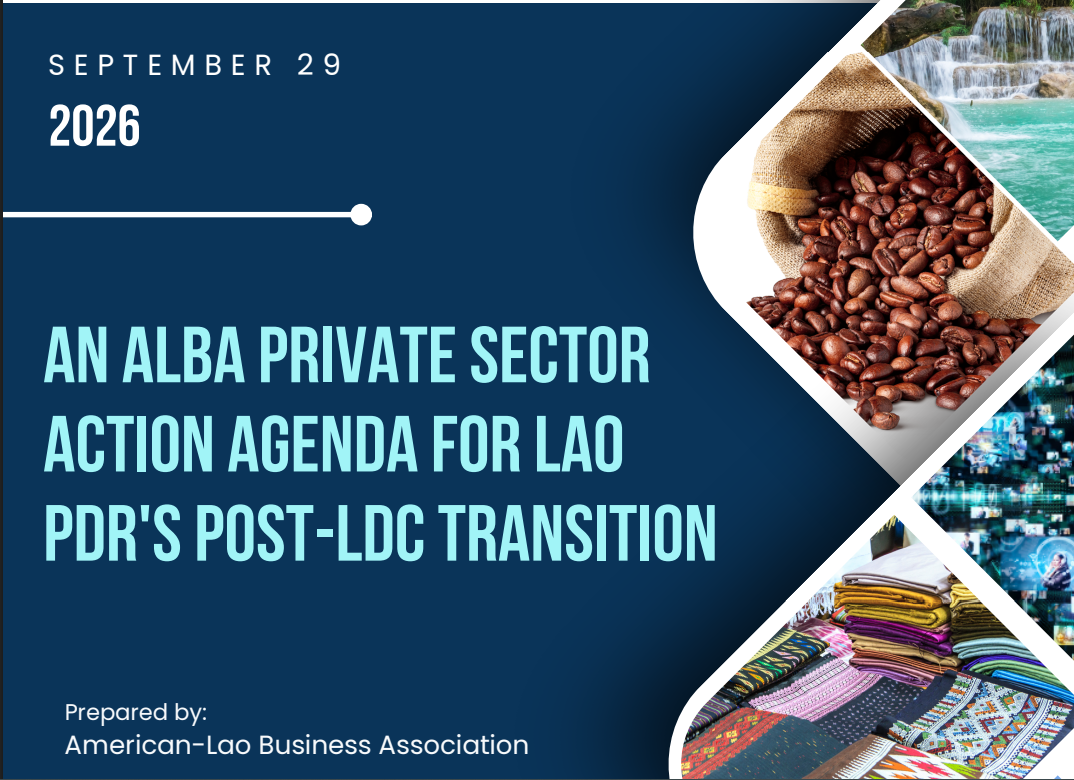
Based on the ALBA Private Sector Action Agenda for Lao PDR’s Post-LDC Transition · Prepared by Jacqueline J. Spence, President · 29 September 2026
Lao PDR is scheduled to graduate from Least Developed Country (LDC) status on 24 November 2026. The American-Lao Business Association (ALBA) has published a private sector action agenda for the 2026–2029 transition period. It sets out how Lao businesses, and ALBA itself, can use the window to prepare for a changing trading environment.
In short: graduation does not end every LDC-related benefit on one day. Each trade preference, market-access arrangement and support measure has its own transition rule, so exporters need product- and market-specific guidance, and they need to compete on quality, standards and brand rather than on tariff preferences alone.
1What graduation does and does not change
Trade preferences, market-access arrangements and support measures each follow their own transition rules. Some end at graduation, some continue for a defined period, and others depend on the policy of the market or institution providing them.
The World Trade Organization has encouraged preference-granting members to provide a smooth transition before withdrawing duty-free, quota-free access. WTO members also agreed to a three-year transition for certain WTO provisions, with continued access to LDC-specific technical assistance and training.
The commercial impact differs by company. It depends on the product, destination market, tariff regime, rules of origin, certification requirements, buyer expectations and each partner’s transition policy. Exporters need clear answers to practical questions:
- What tariff will apply, and will rules of origin or certificate requirements change?
- What happens to landed cost, and can the company keep the same buyer?
- Where can the company get specialist support?
- Which other markets are realistic?
ALBA’s view is that the private sector response should focus on readiness, not anxiety.
2The Government’s position: a Smooth Transition Strategy
The Lao Government treats graduation as a major milestone and a new stage of development, not the end of development efforts. It is implementing a Smooth Transition Strategy for 2026–2029.
At the 81st United Nations General Assembly in New York on 26 September 2026, Deputy Prime Minister and Minister of Foreign Affairs Thongsavanh Phomvihane reaffirmed the country’s commitment to graduation. He asked international partners for predictable transition support, smooth adjustments to International Support Measures (ISMs), and expanded concessional financing to protect development gains and strengthen economic resilience.
The Ministry of Foreign Affairs has also briefed the private sector and other stakeholders. The briefing stressed that businesses should prepare to produce high-quality Lao goods that can compete in regional and international markets, and it framed the transition as a chance to move toward greater economic self-reliance.
3ALBA’s five-pillar action agenda
ALBA says it will not try to become a trade ministry, standards body or technical-assistance agency. Its strength is connecting Lao companies, public agencies, U.S. and ASEAN business networks, buyers, investors, service providers and development partners. It measures success by commercial results rather than the number of events held.
| Pillar | What ALBA does | Business result sought |
|---|---|---|
| Understand | Translates post-LDC changes into clear, product- and market-specific guidance through a plain-language LDC Graduation Business Note, product-market fact sheets and sector briefings. | Companies know what changes, when, and what to do. |
| Prepare | Runs an Export Readiness Check, connects gaps to specialist clinics and referrals, and helps each firm leave with an action plan. | More firms meet buyer, standards, branding, logistics and finance requirements. |
| Connect | Builds a curated pipeline of buyers, distributors, investors and service providers, with focused matchmaking and follow-up. | More qualified commercial relationships, not just more networking events. |
| Diversify | Develops U.S. niche markets and ASEAN markets (Thailand, Vietnam, Singapore, Malaysia and others) through opportunity briefs. | More markets, products, channels and investment relationships. |
| Advocate | Keeps a private sector issue tracker, convenes an LDC Graduation Working Group and publishes a Lao Business LDC Graduation Monitor. | Specific constraints are understood, assigned and addressed by the right actors. |
The agenda also defines ALBA’s roles: lead business-facing initiatives, convene the right actors around a defined problem, partner where capability sits elsewhere, refer companies to qualified specialists, and advocate using documented business evidence.
4Flagship program: Made in Laos Export Readiness series
The series becomes a working export-readiness platform built on one model: 7 Series, 7 Case Studies, 7 U.S. and ASEAN Opportunities. Each session starts with a real Lao business case, unpacks what it takes to enter a market, and ends with a concrete opportunity or next step.
Each case study answers questions such as:
- What was the product and target market, and what did the business get right?
- What went wrong or cost more than expected?
- What standards, certificates and documentation were required, and what were the real logistics and market-entry costs?
- What did buyers care about most, and what would the company do differently next time?
Each market opportunity covers who buys the product and through which channels, which buyer or distributor to approach, relevant standards, customs, labeling and sanitary/phytosanitary requirements, typical volume, price and quality expectations, a realistic logistics route, which institutions can verify requirements, and the next commercial action for an interested Lao firm.
5Priority sectors and markets
ALBA argues that diversification is not a choice between the United States and ASEAN, because the two play different roles. ASEAN offers proximity, established supply chains and lower market-entry friction. The United States offers niches for differentiated products, diaspora and business networks, and opportunities for investment and specialist partnerships.
| Sector | Near-term angle | Likely market emphasis |
|---|---|---|
| Specialty coffee and tea | Origin, quality, storytelling and direct buyer relationships | U.S. niches and ASEAN specialty channels |
| Processed agriculture and selected foods | Value-added products with clearer shelf life and higher value per kilogram | ASEAN first for many products; selected U.S. niches |
| Textiles, handicrafts and specialty consumer goods | Design, provenance, craftsmanship and small-batch differentiation | U.S. specialty and e-commerce; ASEAN urban markets |
| Tourism-related products and services | Experience-based products, itineraries and business-to-business distribution | ASEAN regional travel and long-haul niches |
| Digital and professional services | Services delivered remotely or through regional partnerships | Selected U.S. and ASEAN partnerships |
| Logistics-related services | Services linked to Laos’ growing role in regional transport and trade corridors | Primarily ASEAN and regional |
Some firms may reach buyers quickly after fixing packaging, documentation or pricing. Others will need a longer runway for product consistency, certification, scale, working capital or logistics redesign.
6Roadmap: October–December 2026 and beyond
ALBA says the first 90 days should be deliberately narrow: establish useful information, a credible company pipeline and a small number of commercial tests, rather than launching every initiative at once. The six priorities are:
- Publish a short, verified LDC Graduation Business Note on what is changing, what is not automatic, and where to check market-specific rules.
- Create an initial exporter cohort and readiness baseline.
- Reformat the Made in Laos Export Readiness series around the 7 · 7 · 7 model.
- Build a qualified buyer and partner pipeline in two or three priority sectors and pilot focused matchmaking with follow-up.
- Launch a private sector issue tracker and convene a lean LDC Graduation Working Group with partners such as LNCCI, relevant agencies, exporters and development partners.
- Issue a short first Lao Business LDC Graduation Monitor by year-end.
After that, the agenda sets three phases:
- 2027, market development and export readiness: expand company diagnostics and targeted referrals, publish product-market opportunity briefs, run curated buyer and distributor matching, and issue periodic Monitor updates.
- 2027–2028, investment and market expansion: support the strongest firms to scale, connect them to investors, banks, logistics partners and technical providers, and develop sector investment propositions where commercial demand is evident.
- 2028 onward, sustainable competitiveness: institutionalize what works, maintain business intelligence and buyer networks, and scale only initiatives that show measurable commercial value.
7What it means for businesses
The agenda points Lao companies toward readiness over anxiety, and toward commercial results over activity.
Check the rules for your product and market
Verify tariffs, rules of origin, standards and transition arrangements with authoritative sources before making commercial decisions.
Get export-ready before meeting buyers
Fix product consistency, packaging, documentation, pricing and compliance first, so introductions lead somewhere.
Build qualified relationships
Seek curated introductions to buyers, distributors, investors and service providers, with clear follow-up after each meeting.
Diversify markets over time
Match each product to the market where it has a realistic value proposition, whether ASEAN, U.S. niches or both.
8The bottom line
Graduation is an important national milestone but not the finish line. The question for Lao businesses is how they improve products, meet standards, manage costs, build brands, reach buyers, attract investment and compete in more markets. ALBA’s role is to translate change into business action, prepare credible firms before taking them to market, connect them to qualified buyers, investors and specialists, help diversify commercial relationships, and bring documented business evidence into the policy process.
About the report
- Publisher: American-Lao Business Association (ALBA)
- Prepared by: Jacqueline J. Spence, President, ALBA and Mekong Nexus Partners
- Date: 29 September 2026, Vientiane, Lao PDR
- Period covered: 2026–2029 transition window, with an October–December 2026 action plan
- Format: 14-page action agenda
Sources cited in the agenda: UN LDC Portal · Smooth Transition Strategy · WTO: Graduating from LDC status · Lao News Agency (KPL), 28 September 2026. Market-access arrangements are provider- and product-specific and should be verified before any commercial decision.
Understand · Prepare · Connect · Diversify · Advocate
Strengthening commerce between the United States, ASEAN and Laos while supporting Laos’ development as an international business hub.
Want the full agenda?
Read the complete ALBA Private Sector Action Agenda for Lao PDR’s Post-LDC Transition, with all tables, roadmap and sources.
Preview the report on this page
If the preview does not load, open the PDF in a new tab.